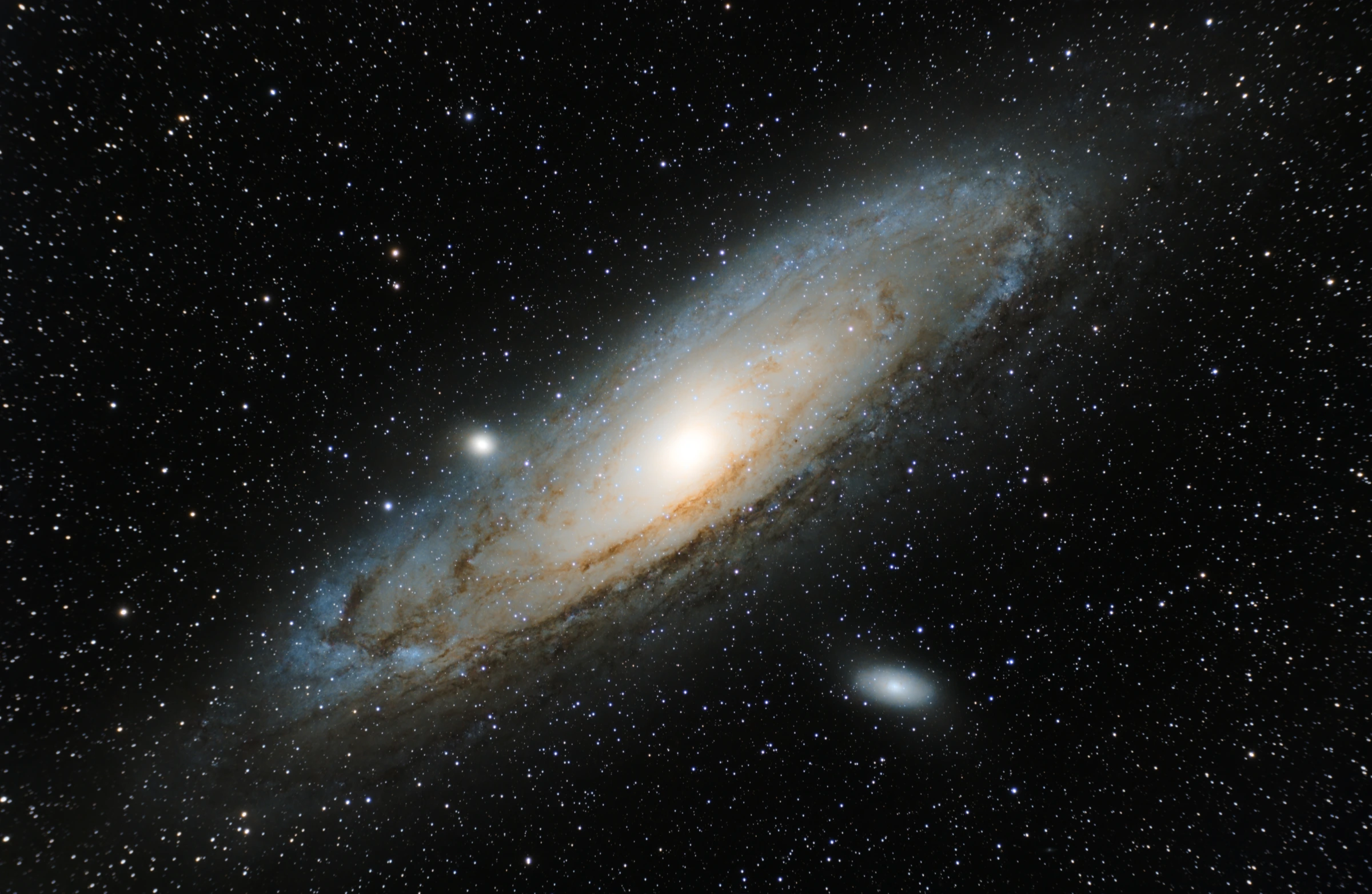
The image at the top shows our closest galactic neighbour, the Andromeda Galaxy. At 2.5 million light years distant, Andromeda is a stone's throw from us in cosmological terms, and for amateur astrophotographers like myself, it's extremely fortunate we have such a nearby neighbour.
Despite distant galaxies moving away from each other on very large scales due to the expansion of the universe, Andromeda is close enough to us for gravity to win out, and this means in about 4.5 billion years Andromeda and our galaxy the Milky Way will merge together.
Interestingly, despite being twice as large as the Milky Way at 260,000 light years across, it's believed Andromeda and the Milky Way have a similar mass and therefore a similar amount of matter.
High resolution image available here.
Exploring the Image
Since the acquisition details for this image are quite short, I thought it would be fun to really dive into the image, as this is the cleanest and most detailed image I've captured yet, to see what I could pick out in Andromeda itself.
The most obvious and, as far as I can tell, most well-known object within Andromeda is NGC 206. You can clearly spot it in my image as a particularly bright blue patch in the outer spiral arm of the galaxy.
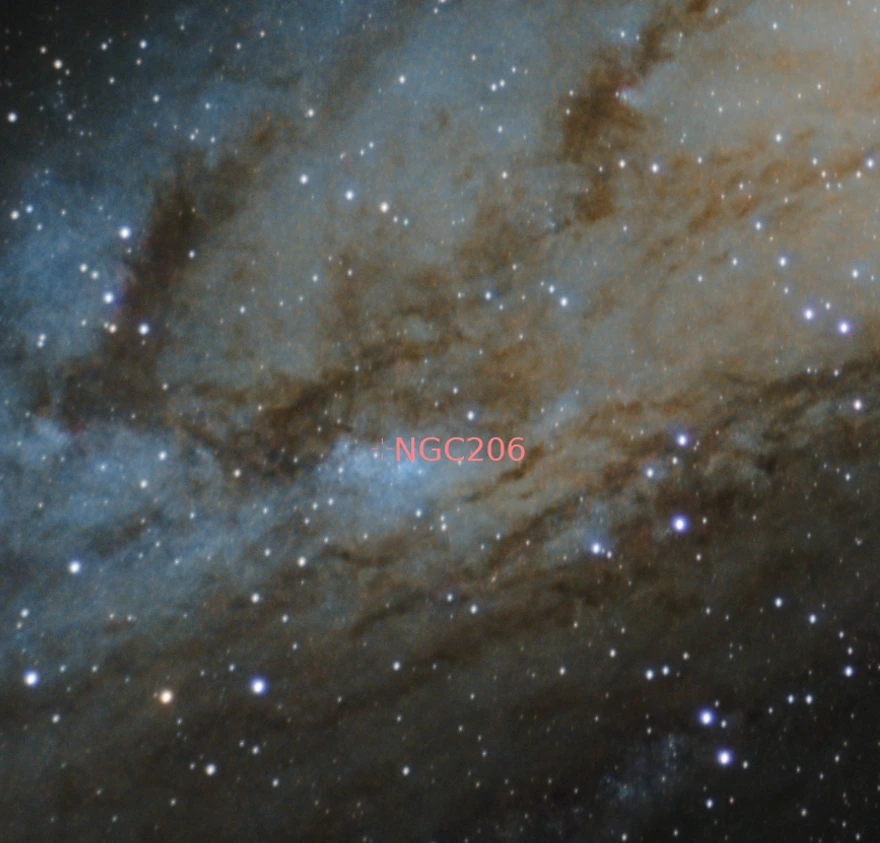
NGC 206 is what's known as an OB association. This means it is a dense cloud of O- and B-type stars, which are very hot and large blue stars that are short-lived compared to stars like our Sun, since they burn through their hydrogen faster.
It's believed NGC 206 is actually one of the largest star clouds in our local group of galaxies and additionally, it contains a number of Cepheid variables, stars which pulsate with a predictable period and luminosity, making them great markers to measure cosmic distances.
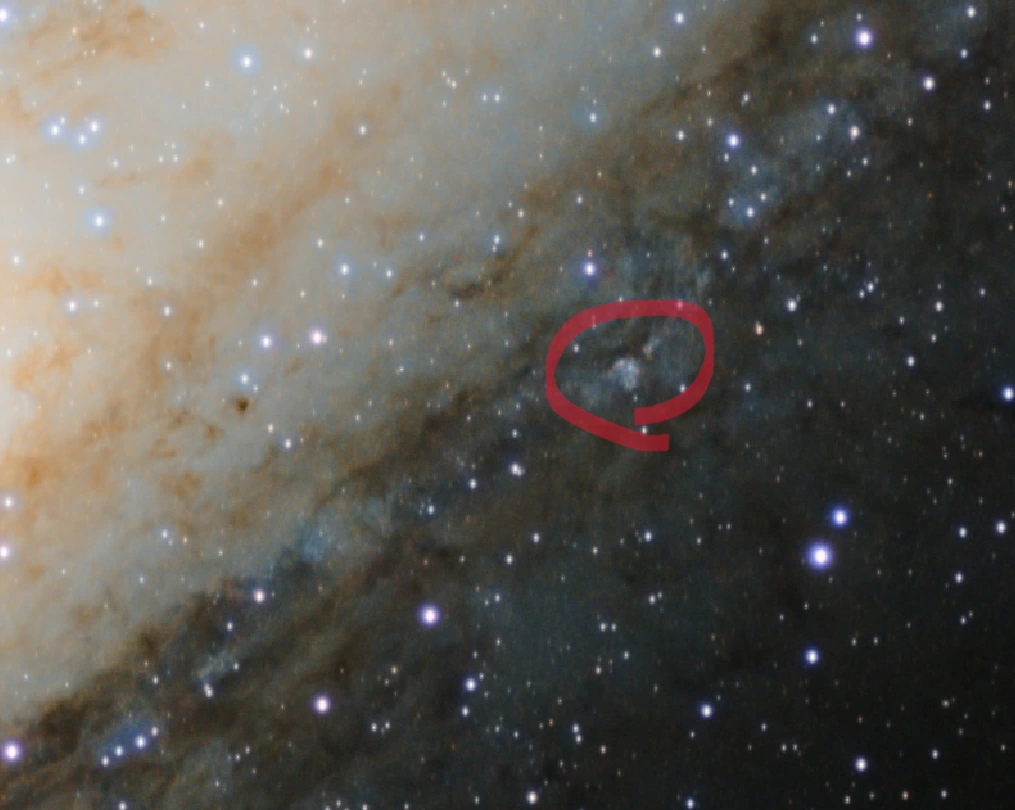
Another thing I noticed while inspecting my image in detail was the bright blue spot circled. It looked to me like the edges had some hints of reddish Hydrogen alpha, while the centre appeared to be a bright blue of Oxygen III, suggesting this may be some kind of nebula.
A quick search for nebulae in Andromeda didn't turn up much other than a few articles on planetary nebulae, but planetary nebulae are too small to show up clearly in the dust lanes (dark streaks) of the galaxy like this object was.
Unfortunately, I'm yet to find a name or designation for this object, but searching on Google for Andromeda images with Hydrogen alpha data showed this same spot much more clearly and confirmed without a doubt this was some kind of Hydrogen alpha region.
I was super pleased I'd managed to draw an extragalactic nebula out of this image, so I decided to go hunting for more fuzzy red spots. After cross-referencing with some truly incredible images of Andromeda shot in H alpha and Oxygen III, I spotted an area where I seemed to have picked up a fair number of H alpha photons and decided to do some more adjustments to really try to bring the nebulae out clearly. This, of course, ruined the rest of the image, but ended up showing the Hydrogen regions much more clearly than I expected.
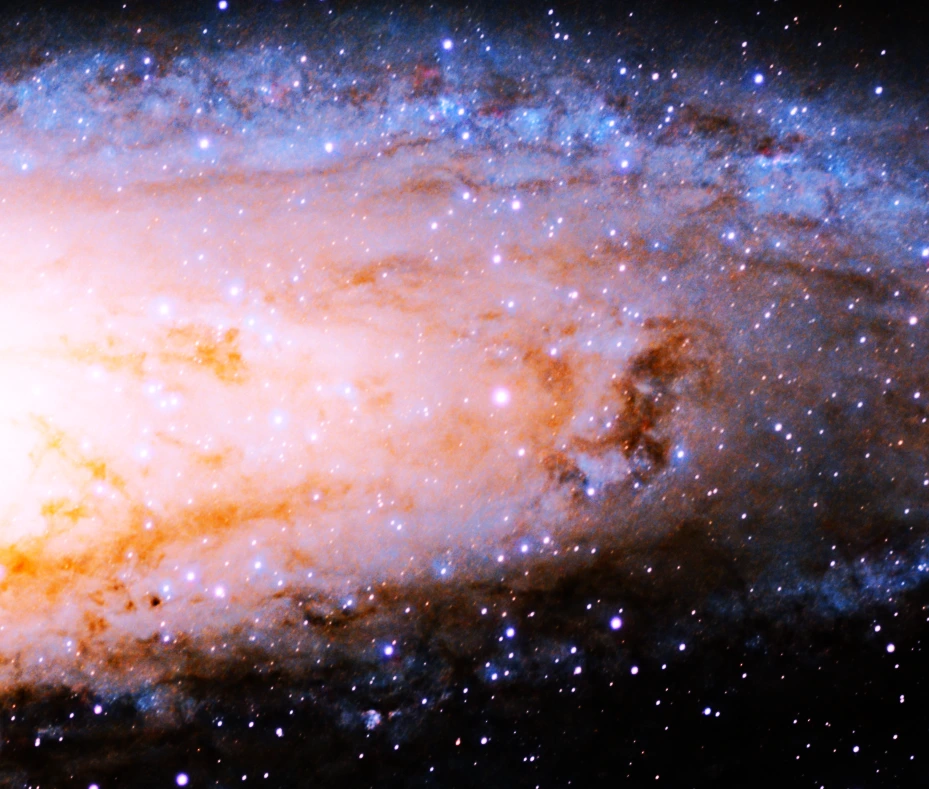
Something really excites me about capturing the details of objects within another galaxy, and while I will be leaving Andromeda for now, once I have a dedicated astrocamera and some narrowband filters I'll definitely be going hunting for more extragalactic nebulae!
Acquisition details
The image was shot over two nights for a total exposure time of 2 hours and 15 minutes. Andromeda is considered a fantastic beginner target because of its size and brightness, so even with such little exposure I was able to capture a great deal of detail.
In contrast to my previous image of the Gamma Cygni Nebula (where I tried to beat terrible sky conditions with lots of exposure time), with the return of astronomical darkness in early August, I decided to travel to a Bortle 4 site on a moonless night. This proved to be worthwhile as each of my sub-exposures was very clean with Andromeda clearly visible in each.
I was hoping to complete the image in one night, but on the first, cloud cover formed unexpectedly after only 30 minutes of imaging, so I was forced to head home and wait for a second night. Then after a few falsely forecast clear nights and one where I forgot to charge the camera before I left (very silly), I finally caught a second chance just before the moon was going to be too bright and up too late for me to get high quality data.
The details of the image are as follows:
- 45 x 180s unfiltered from Bortle 4 with an unmodified Canon EOS 2000D, shot through a SkyWatcher EvoStar 72ED driven by an Explore Scientific iEXOS 100 equatorial mount.
- 30 darks, 20 flats and 40 biases used to calibrate sub-exposures
- Pre-processed and stacked in Siril with dark frame optimisation and FWHM weighting for each sub in the stack.
- Background extraction with GraXpert, followed by SPCC and deconvolution in PixInsight (unfortunately my BlurXterminator free trial expired and I am still saving to purchase the software), GraXpert denoising, and StarNet star removal.
- Generalised hyperbolic stretch on the starless image and star mask, followed by masked saturation adjustments on the starless image and green noise reduction.
- Re-screen stars and finally an additional light touch of denoising